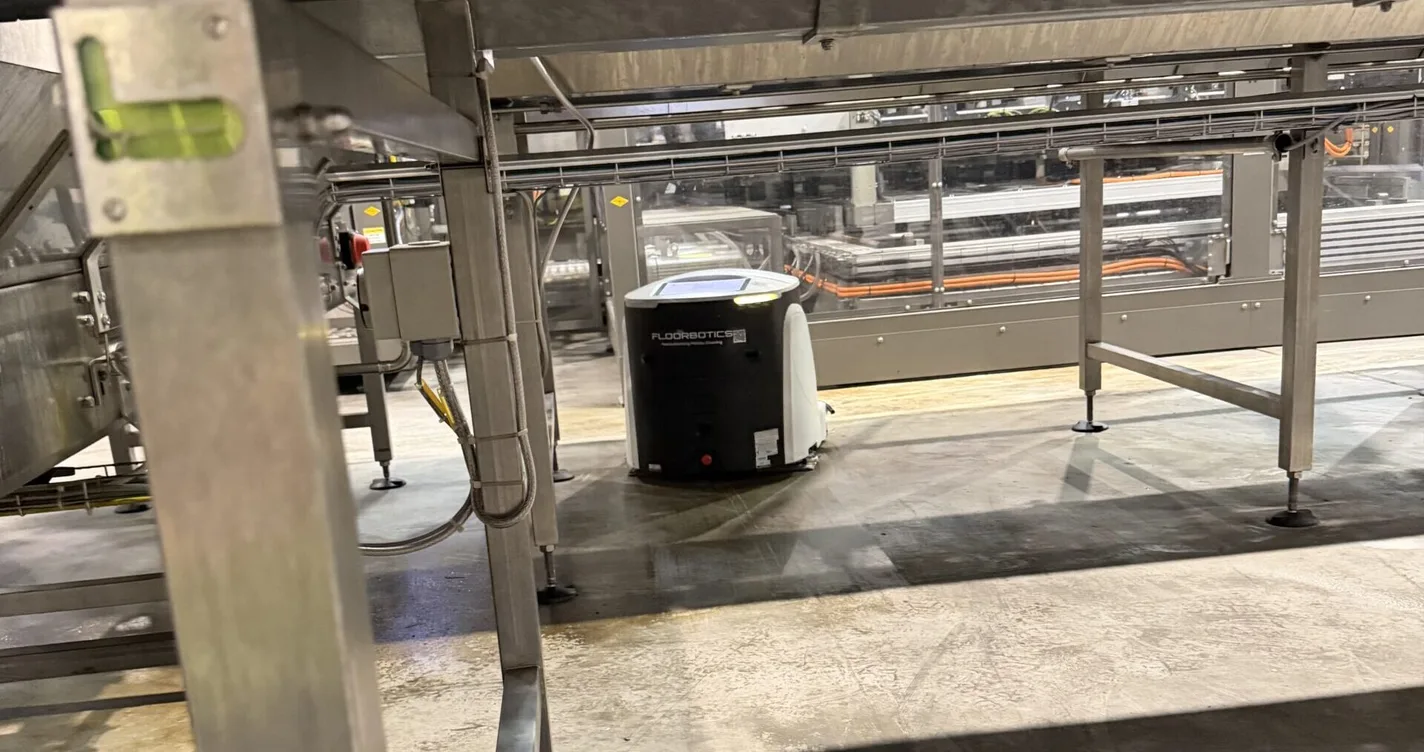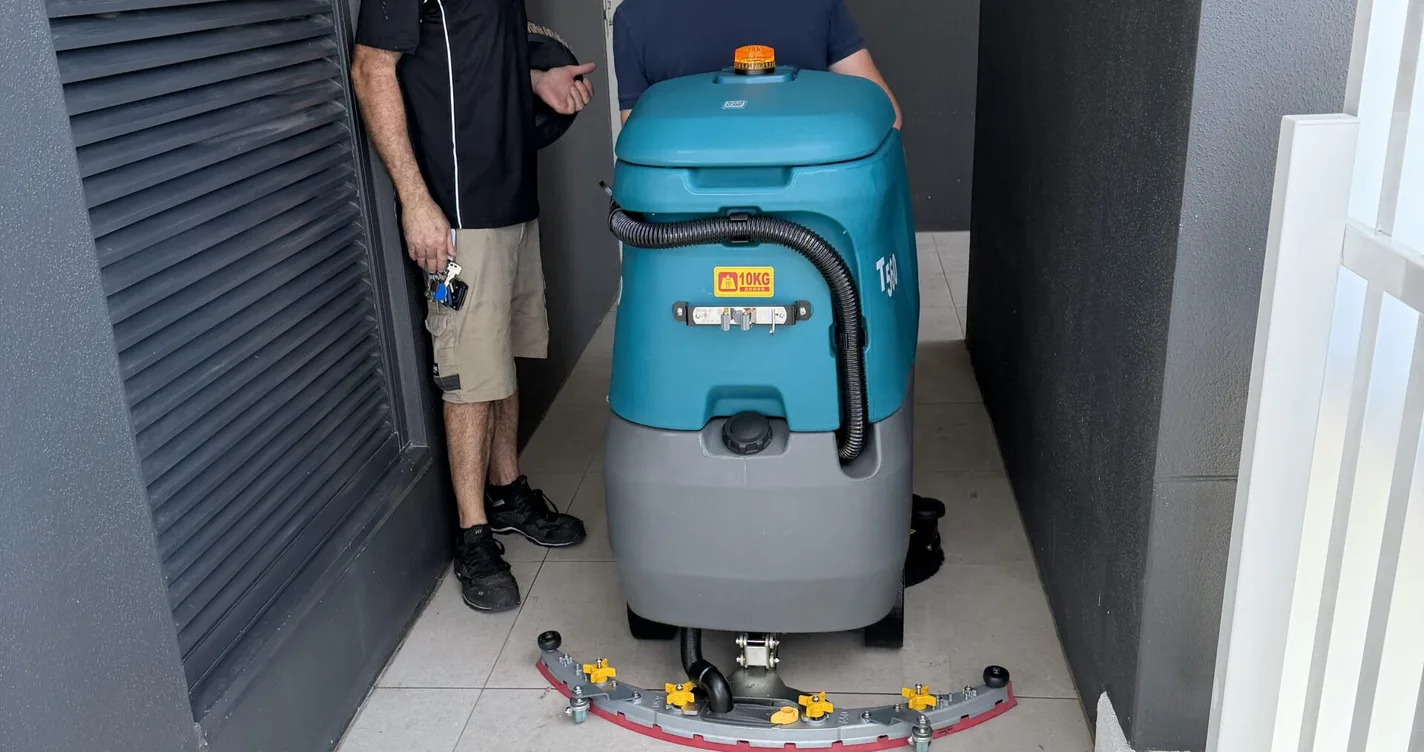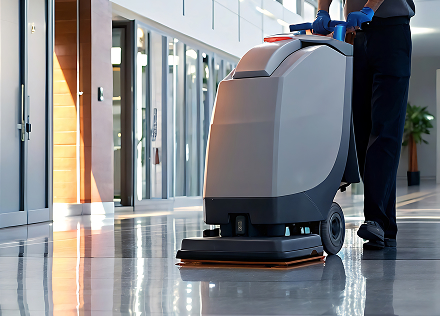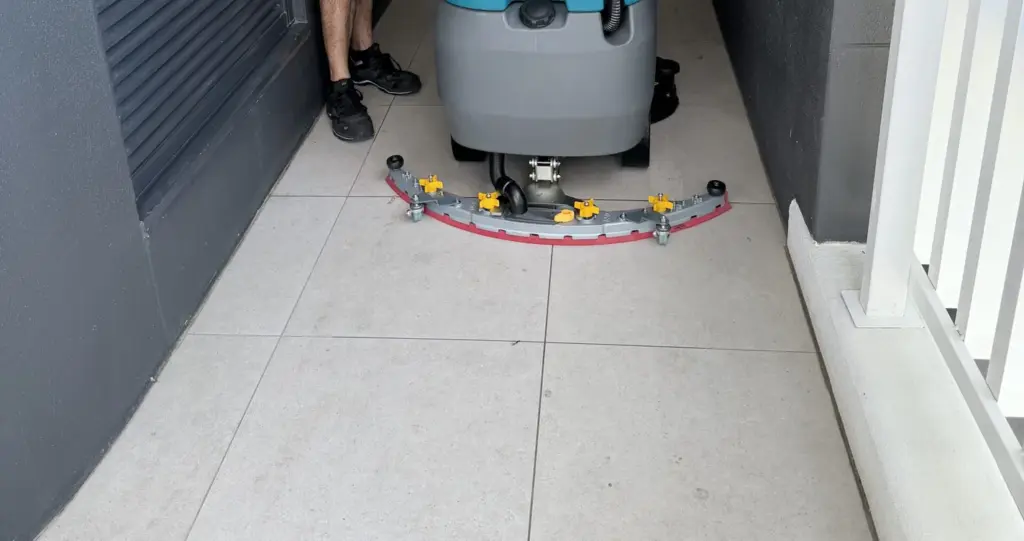
A commercial floor scrubber costs about $1,100 to $10,000 for a small walk-behind and $10,000 to $31,000 for a large walk-behind. Ride-ons start around $10,000 and pass $140,000 for the biggest industrial machines. Those figures are the RRPs on our own product pages, excluding GST. A floor scrubber is a machine that puts down water and detergent, scrubs the floor with brushes or pads, and vacuums the dirty water back up in one pass.
The purchase price is only part of the bill. What the machine costs you over five years depends just as much on batteries, squeegees and how it’s looked after.

What does each type of floor scrubber cost?
The price follows the cleaning width, the tank size and whether you walk behind it or sit on it. Here’s the spread across machines we sell, using the RRP on each product page.
| Type | RRP range (ex GST) | Examples we sell | Suits |
|---|---|---|---|
| Micro and compact walk-behind | $1,092 to $5,571 | i-team i-scrub 21B $1,092, Tennant CS5 $3,639, Tennant T260 $4,305, Tennant T1 $5,571 | Bathrooms, cafes, small retail |
| Mid-size walk-behind | $6,965 to $14,310 | Tennant T360 $6,965, Tennant T2 $9,765, Nilfisk SC401 $9,955, Tennant T391 $14,310 | Schools, clinics, aged care wings |
| Large walk-behind | $18,579 to $31,271 | Tennant T300 $18,579, Tennant T500e $18,631, Tennant T600e $31,271 | Supermarkets, long corridors, daily heavy use |
| Micro ride-on | $10,490 to $16,864 | Tennant T560 $10,490, Tennant T581 $14,876, Nilfisk SC2000 $16,864 | Mid-size floors with tight turns |
| Ride-on | $21,576 to $49,178 | Tennant T681 $21,576, Tennant T7 $27,015, Tennant T12 $42,792, Tennant T16 $49,178 | Warehouses, shopping centres |
| Industrial ride-on | $74,995 to $142,306 | Tennant T17 $74,995, Nilfisk SC8000 LPG $128,401, Tennant T20 $142,306 | Large plants, multi-shift sites |
The overlap surprises people. A big walk-behind like the T600e costs more than several ride-ons. You’re paying for a wide scrub path and large tanks in a machine that still fits places a ride-on can’t reach.
Hardware stores sell battery scrubbers for around $1,900 to $3,500. They’re built for light use. On a commercial floor cleaned every day, a cheap machine usually costs more by the time you’ve counted the downtime.
What makes one scrubber cost more than another?
Four things drive most of the gap between a $5,000 machine and a $30,000 one. They are the width of the scrub path, the size of the tanks, the battery chemistry, and how heavy the frame is.
Wider paths and bigger tanks mean fewer passes and fewer trips to the tap. That matters more than it sounds. When Shaun Herman, who runs CC Machines, walks a site, he looks for where the machine will be filled and drained. “If there’s no tap or drain close by, a bigger tank saves a lot of walking back and forth.” On a big floor, a cheaper machine with small tanks pays you back in walking every shift.
Lithium batteries cost more up front than lead-acid. In return they charge faster and need less looking after. Heavier steel frames add weight and price, and they’re the reason some older Tennant machines are still working after 20 years with regular servicing.
How do you work out what you actually need?
Start from the site. Shaun’s checklist covers access and doorways, how much room there is, how many obstacles, and how often the floor needs cleaning.
Ramps decide a lot. “If the site has ramps it needs a self propelled unit, if it’s flat we can usually get away with a walk behind.” Lifts and mezzanines have weight limits that rule out some ride-ons altogether. The floor matters too: a non-slip floor gets a different machine from a flat, smooth one, and oil and grease need a different brush or pad from light dust.
Then check the machine can finish the job. “I work out how long the job should take against the machine’s real coverage rate and battery runtime, so we don’t sell something that goes flat halfway through the shift.” For the detailed comparison on size, our walk-behind versus ride-on guide sets out cleaning rates by floor area.

What does a floor scrubber cost to run?
Running costs are batteries, squeegee blades, brushes or pads, detergent and servicing. Our scheduled servicing starts from $220 ex GST a visit, on fixed quarterly or six-monthly visits at an agreed rate. Battery packs are the largest single replacement. Our walk-behind guide puts them at $500 to $1,200 for a walk-behind and $2,000 to $5,000 for a ride-on.
Neglect costs more than any of those parts. The two faults we’re called out for most right now are scrubbers that won’t pick up water and scrubbers that go flat early. Both usually come down to maintenance that was forgotten:
- Opportunity charging (topping up for short bursts) on lead-acid batteries, which shortens their life.
- Squeegee blades that are never cleaned or rotated.
- Vacuum hoses that are never flushed.
“A lot of call-outs would be avoided,” Shaun says. Our floor scrubber maintenance tips set out the daily, weekly and monthly checks.

Is it cheaper to hire, lease or trade in?
Hiring makes sense if you clean the floor occasionally or want to test a size before you buy. Compact walk-behinds hire from about $80 to $120 a day in Brisbane. Our post on what floor scrubber hire costs has the full rate bands.
For a machine you’ll use every day, buying or lease-to-own usually works out better over time. We offer lease-to-own and long-term hire. Longer hire agreements can run up to sixty months with servicing included in the rate, which spreads the cost and fixes the maintenance bill. We also take machines as trade-ins.
Should you repair the old machine first?
Often, yes. Get the old machine assessed before you budget for a new one. CC Machines started in 2021 as a service business, and sales grew from telling customers when a machine had gone past economical repair. Plenty haven’t.
One facilities manager had two quotes to replace a sweeper that had been taken out of service. It had done about 90 hours. The fault was a throttle neutral switch and some minor parts, and it went back to work for roughly $4,000 against an $80,000 replacement. Scrubbers are the same. A machine that seems dead often needs one part or a battery pack.
Buying a floor scrubber in Brisbane
We supply and service from our Brendale workshop, with genuine parts held there and technicians covering the Tweed to Bundaberg. We’re authorised for warranty repairs on Tennant, Nilfisk, Duplex, Pudu, Pacvac and FloorBotics. Healthcare and aged care sites get a 4-hour priority response.
The RRP on our product pages is a starting point. Your supplied price is quoted once we know the floor, the area and the shift. We can also run a demonstration on your own floor before you commit.
Common questions
How much is a commercial floor scrubber in Australia?
Compact walk-behinds start around $1,100 and most mid-size machines sit between $7,000 and $15,000. Ride-ons run from about $10,000 to over $140,000. These are RRPs excluding GST from our product pages.
How much does a ride-on floor scrubber cost?
Micro ride-ons start at about $10,500. Standard warehouse ride-ons run $21,000 to $50,000, and large industrial machines go past $140,000.
Is a cheap floor scrubber worth it?
For a home or a small room used now and then, it can be. On a commercial floor cleaned every day, weak vacuum pickup and short battery life usually cost more in labour and repairs than the money saved.
Do your prices include GST?
No. The RRPs on our site are shown excluding GST, and your supplied price is confirmed in a written quote.
Get a quote on the right machine
Browse the commercial floor scrubbers we sell with their RRPs, or call 1300 343 246. Tell us the floor type, the area, any ramps or lifts, and how often it’s cleaned, and we’ll quote the machine that fits.