How Floor Area Determines Your Scrubber Type
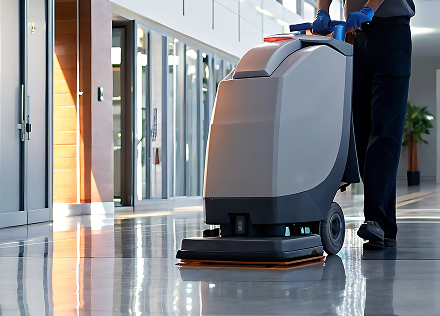
- Under 2,000 sqm: Walk-behind floor scrubbers. Compact, manoeuvrable, cost-effective for retail, cafes, aged care wings, school corridors.
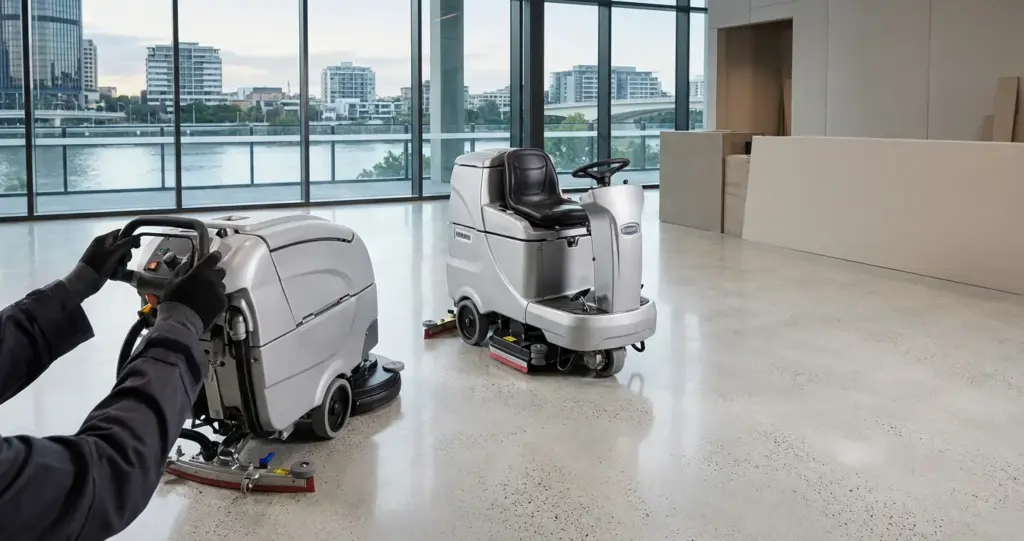
- 2,000 to 5,000 sqm: Either type works, but ride-on saves significant labour time.
- Over 5,000 sqm: Ride-on scrubbers pay for themselves quickly. Warehouses, shopping centres, airports across SE QLD.
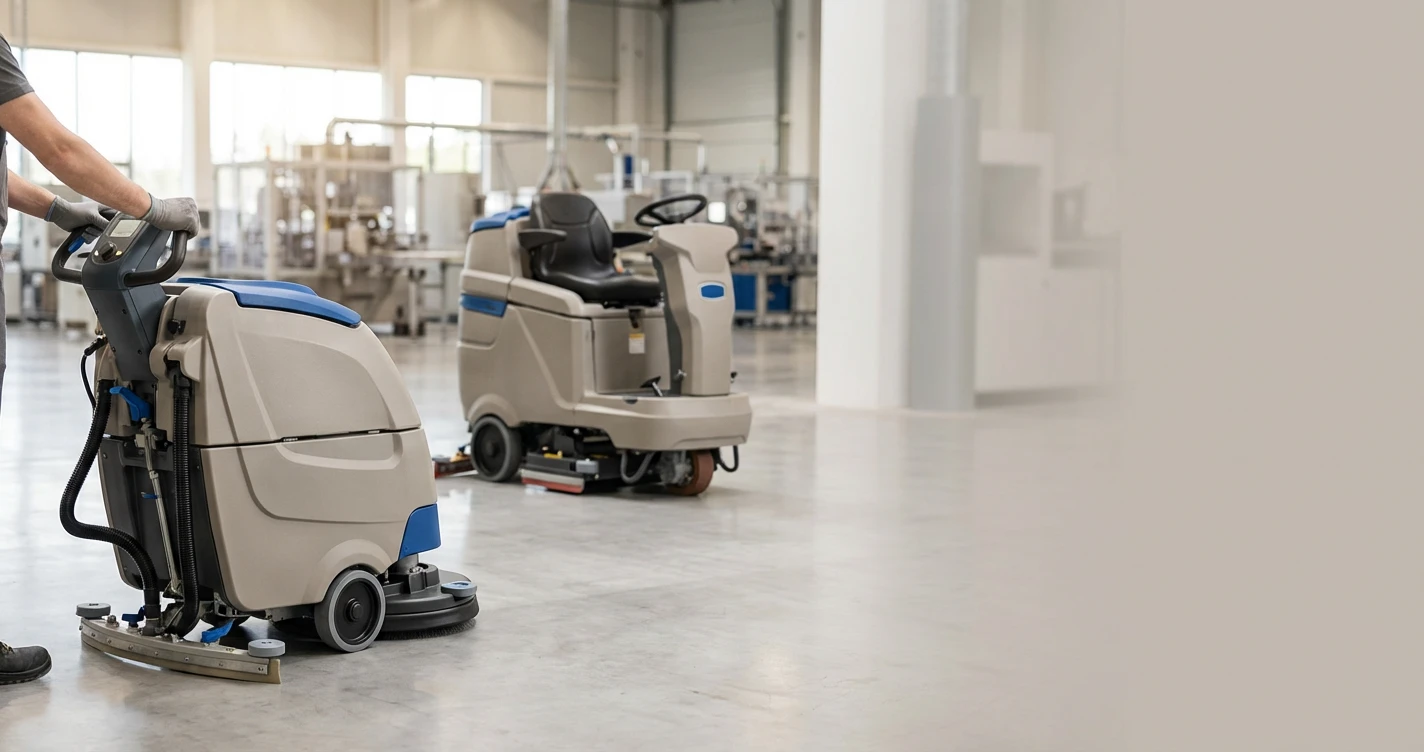
Walk-Behind Floor Scrubbers: Where They Excel
Ride-On Floor Scrubbers: Built for Large-Scale Cleaning
Cost Comparison
|
|
|
|
|
|
|
|
|
|
|
|
|
|
|
|
|
|
|
|
Specifications Side by Side
Machine width is the number people forget. A machine that cleans a wide path is no use if it cannot get through your tightest permanent gap, so measure that before you look at anything else.
| Model | Type | Cleaning path | Solution tank | Run time | Machine width |
|---|---|---|---|---|---|
| Tennant T2 | Walk-behind | 430 mm | 26 L | Up to 2 hrs | 695 mm |
| Tennant T300 | Walk-behind | 600 mm | 42 L | Up to 3.8 hrs | 722 mm |
| Tennant T500 | Walk-behind | 800 mm | 85 L | Up to 5.9 hrs | 973 mm |
| Tennant T7 | Ride-on | 800 mm | 110 L | Up to 4.5 hrs | 950 mm |
| Tennant T12 | Ride-on | 800 mm | 132 L | Up to 4.5 hrs | 990 mm |
Two things fall out of that table. The T500 walk-behind cleans the same 800 mm path as the T7 ride-on, so if your constraint is path width rather than operator fatigue, you do not automatically need a ride-on. And the T500 is 973 mm wide against the T7 at 950 mm, so the ride-on is actually the narrower machine.
What Decides It Beyond Floor Area
Square metres gets you to a shortlist. These four decide which machine off that shortlist actually works on your site.
- Your tightest permanent gap. Not the main aisle. The worst one, between racking and a wall, or between two benches. If it is under 700 mm, a T2 at 695 mm is close to your only option.
- Where it lives between shifts. A ride-on needs a parking bay with power. We have delivered machines that ended up in a corridor because nobody checked the store room had a socket.
- Edge cleaning. Walk-behinds get closer to skirting and under fixtures. If your site is judged on edges rather than open floor, a big ride-on covers ground fast and still leaves you edging by hand.
- Who runs it. Walk-behind training takes about 30 minutes. Ride-on takes one to two hours and the damage risk is higher. On a site with casual or rotating staff, that matters more than coverage rate.
Run time is the other quiet constraint. A T2 gives you up to two hours before it needs charging. If your cleaning window is three hours, that machine cannot finish the job regardless of how well it fits.
Tank Size Sets Your Real Cleaning Rate
Coverage rate assumes the machine never stops. It does stop, to empty and refill.
The T2 carries 26 litres, the T7 carries 110. On a large floor the T2 operator will be walking back to the tap several times a shift, and that time is not in any coverage figure. It is the same trap as buying a fast machine with a small tank in the robotic range, where a big coverage number and a small tank quietly turns cleaning labour into refilling labour.
If you are unsure, hire the machine for a fortnight and count the refills on your own floor. That number settles the argument faster than any spec sheet.
FAQ