Choosing a commercial floor scrubber comes down to three things in a fixed order: the floor surface, how hard the machine will work each day, and whether it fits the building. Price comes last. Get the first three right and the price sorts itself out, because the machine you need is the one that stops costing you money.
We spend our days inside hospitals, aged care homes, schools, hotels, warehouses and retail sites across South East Queensland, servicing the machines people bought. The ones we collect early were almost never broken. They were the wrong scrubber for the floor or the space. Here’s how we help people avoid that.
Why floor type decides more than anything else
Match the scrub system to the floor before you look at size, brand or price. A flat disc machine on textured safety flooring will skim the surface, leave black marks and puddle water, no matter how much you paid for it.
The floors that punish the wrong choice are safety and non-slip surfaces: textured tiles, floors with deep grout lines, commercial kitchens, aged care bathrooms and some school corridors. They trap dirt in the profile, and a disc pad can’t reach it. Cylindrical brush machines dig into the texture and lift debris into a tray. Smooth vinyl, sealed tile, epoxy and sealed concrete are forgiving. Most machines clean them, so the choice there is about duty cycle and size.
Safety and non-slip flooring. Counter-rotating cylindrical brushes. The Duplex 340 and Duplex 420 are built for exactly this, and we regularly replace cheaper disc imports that failed on these floors.
Smooth vinyl and sealed tile. Hospitals and healthcare sites want consistent cleaning, strong water recovery and low noise. The Tennant T300 and T500 are the machines we see most in Brisbane hospitals for that reason. Quiet, easy to control, streak-free.
Epoxy and concrete. Warehouses, halls and industrial floors reward runtime, durability and operator comfort. The Tennant T7, T12 and Nilfisk BR755 are built for long daily use. Operators tell us bare concrete chews through standard red pads and squeegee rubber in weeks, so pad and brush selection matters as much as the machine.
How hard will it work each day?
Duty cycle is the second decision, and it’s the one that decides how long the machine lasts. A scrubber that finishes your floor on one charge with capacity to spare will run for years. One that needs a mid-shift top-up is undersized, and undersized machines burn through batteries.
Light duty. Small areas, occasional cleaning. A compact machine like the Duplex 280 suits small offices and low-traffic areas. Not a hospital machine, and not for daily commercial use.
Medium duty. Schools sit here. The Nilfisk SC500 and Tennant T290 balance price, reliability and parts availability for regular use without heavy-industrial cost.
Heavy duty. Hospitals, airports, distribution centres. The T7 and T12 are the common choice because they carry long battery life, strong scrub pressure and good water recovery, day after day.
The rule of thumb: the machine must complete the full clean on one charge. A pack that’s run flat and partially recharged before the next use overheats, and heat is what kills batteries. Machines that should give years of battery life fail inside twelve months on sites that ignore this. We cover the whole subject in the end-of-shift habits that protect the pack.
Will it fit the building?
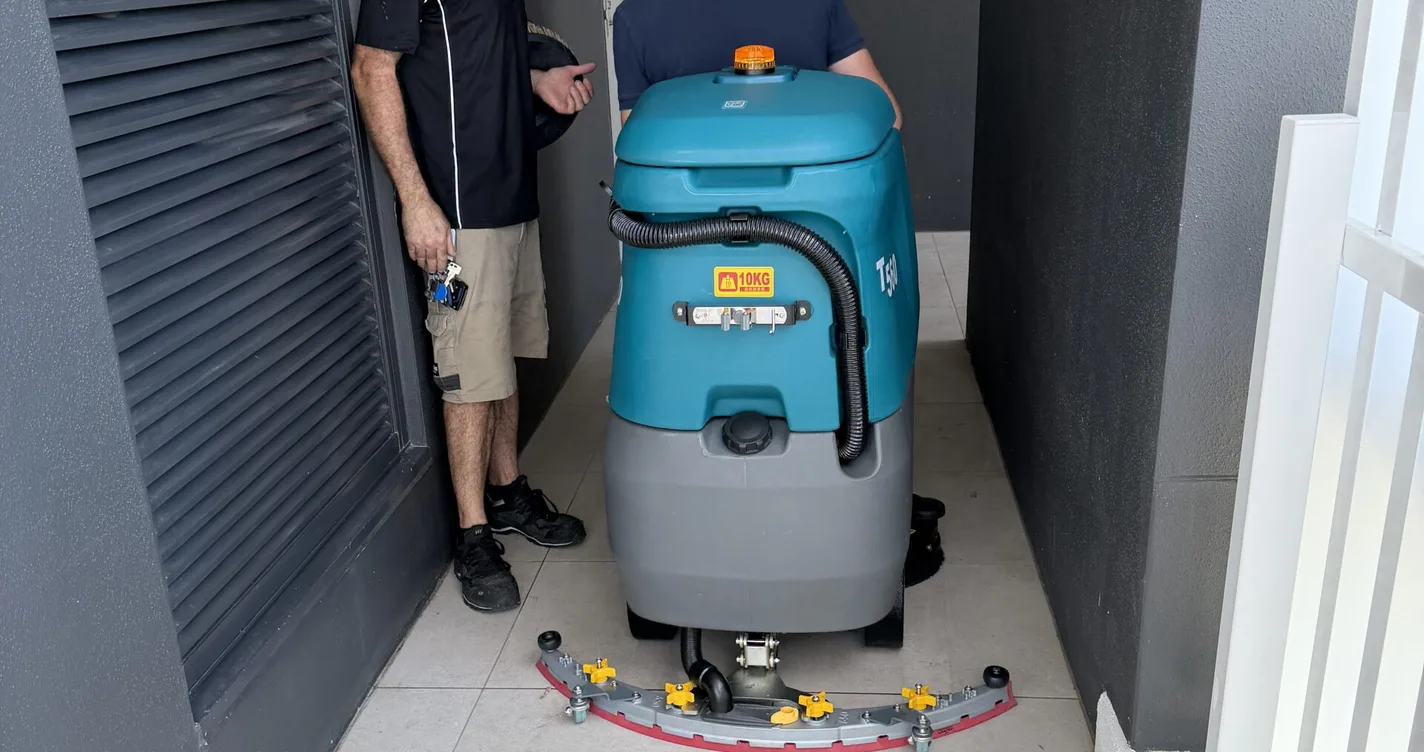
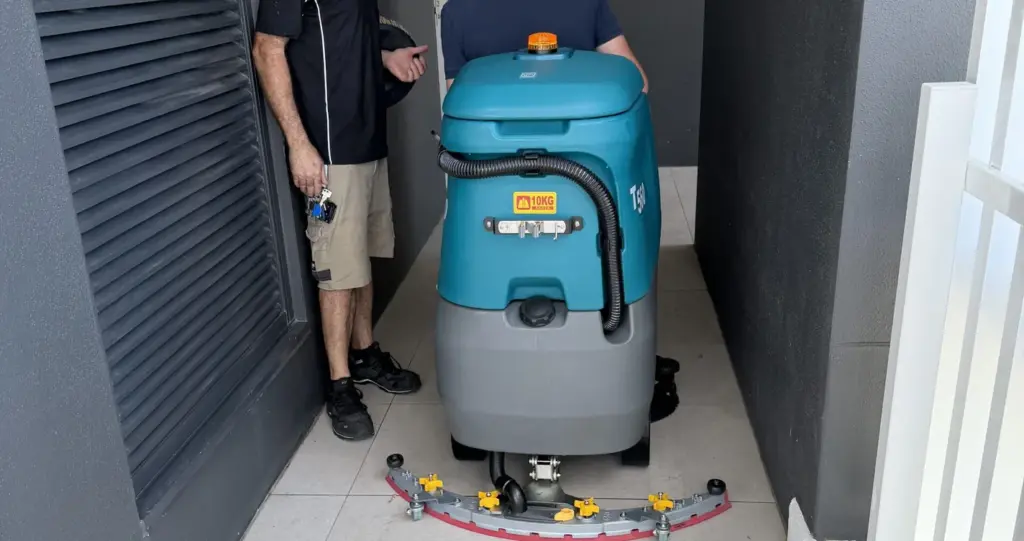
Layout rules machines in or out before size does. Measure the tightest permanent gap the machine has to pass, the doorway into the cleaner’s room, and the goods lift. A ride-on that suits the floor area but won’t fit the lift is an expensive delivery to watch turn around.
Ramps matter too. Pad-assist walk-behinds, where the spinning pad pulls the machine forward, struggle on inclines. A ramp needs a traction-drive machine. Storage decides more purchases than people admit: a large ride-on with nowhere to live gets left in a corridor and damaged.
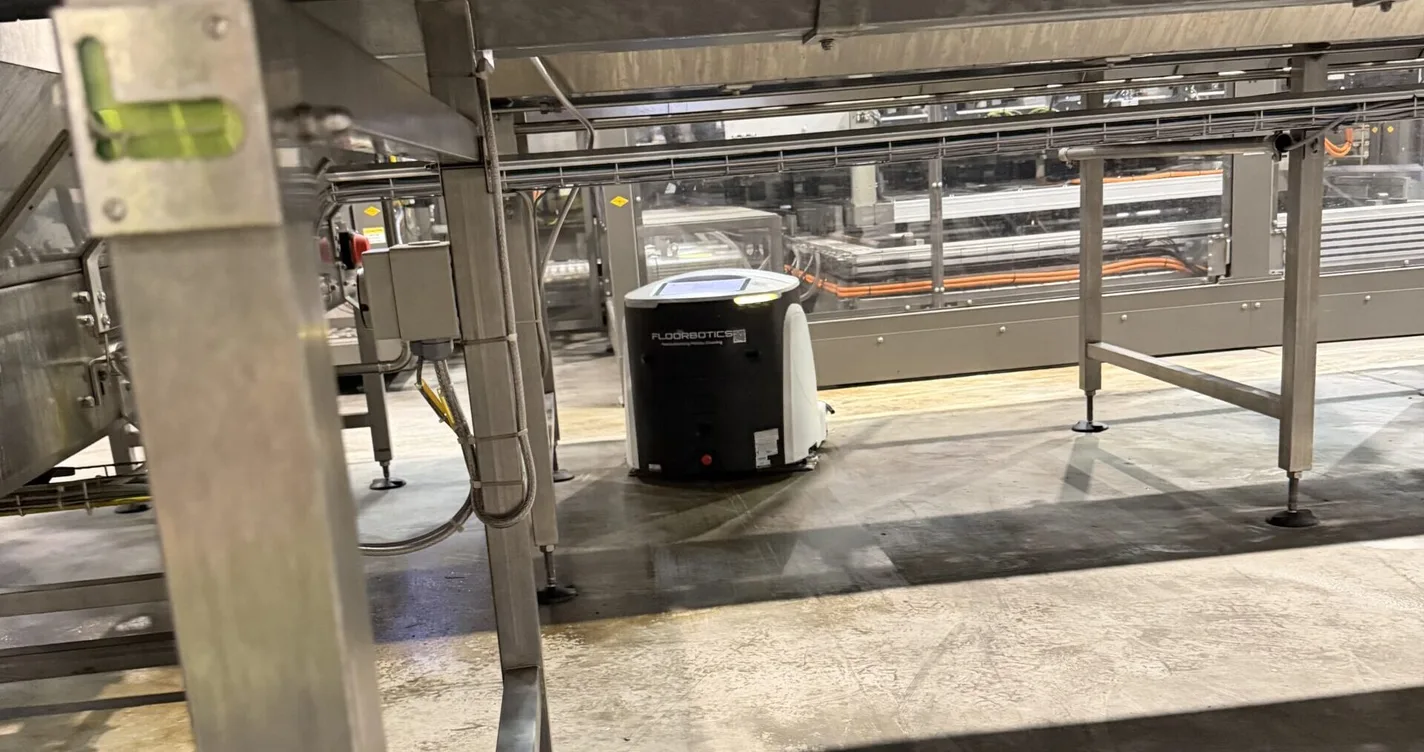
Walk-behinds suit tight or complex layouts, obstacles, edge cleaning and operators who want control. Ride-ons suit large open floors where time matters. On some sites a wide walk-behind does the same work as a ride-on with less risk of damage. The walk-behind versus ride-on guide sets out the thresholds by floor area.
Read the tank and brush figures, not the headline
Two numbers on the spec sheet decide more than the brand: solution tank size and cleaning path width. Tank size sets how long the machine runs before someone has to refill it. Path width sets how fast it covers the floor. A fast machine with a small tank converts cleaning labour into refilling labour.
Tennant’s published walk-behind figures run from a 430 mm path and 26 litre tank on the T2, through 600 mm and 42 litres on the T300, to 800 mm and 85 litres on the T500. The T7 ride-on cleans the same 800 mm path as the T500 with a 110 litre tank, and the T12 carries 132 litres. The useful surprise in those numbers is that the T500 walk-behind cleans as wide a path as the T7 ride-on. On a mid-size floor that’s the cheaper machine doing the same job.
Brush pressure is the third figure. Machines that rely on their own weight struggle with stubborn marks. Look for adjustable down pressure if your floor has them.
Noise, hours and who’s in the building
Noise is a specification in aged care, hospitals and childcare, not a preference. If any cleaning happens while people are in the building, the sound level decides whether the machine gets used at all. Some machines carry a quiet mode for wards and resident rooms. Ask for the decibel figure and compare it.
Batteries, warranties and the machines that become painful to own
The battery is the most expensive replaceable part of a scrubber and the most misunderstood. Wet lead-acid needs watering. Sealed gel and AGM are maintenance free. Lithium allows opportunity charging and lasts more cycles, though some aged care and hospital sites still prefer sealed lead-acid for compliance reasons. Whatever the chemistry, the routine is the same: on charge at the end of every shift.
Warranties need reading. Long headline numbers often cover non-wear parts only, and on a scrubber most of the parts that fail are classed as wear items. Ask what’s covered in the first twelve months, what’s parts only, and what labour applies.
Unsupported imports are the machines we can’t help with. No local parts, no service support, so a simple repair becomes a six-week wait for a part from overseas. Tennant and Duplex parts are stocked in Brisbane and our vans carry common spares, which is most of the reason those brands keep running.
What does a commercial floor scrubber cost in Australia?
For small walk-behind scrubbers, entry-level machines run about $4,000 to $5,000, mid-range around $6,000 to $7,000, and premium long-life machines around $10,000. Ride-ons and large-area machines run well into five figures.
Higher up-front cost usually buys better batteries, better squeegee systems and longer service life. The cheapest scrubber is rarely the cheapest to own. The hidden cost we see most is poor water pickup: weak vacuums and low-quality squeegees leave floors wet, which adds labour time and complaints.
If the number is the problem, hiring a floor scrubber in Brisbane for a fortnight tells you what you actually need before you spend it.
Typical recommendations by site type
- Hospitals. Tennant T7 and T12. High uptime, fast parts support.
- Aged care. Duplex 340 and 420. Built for safety and textured flooring.
- Schools. Nilfisk SC500 and Tennant T300. Reliable and cost-effective.
- Hotels. Tennant T500 and Duplex 420. Compact, versatile, easy to use.
- Warehouses. Tennant T7 or Nilfisk BR755 on concrete, with a brush rather than a pad.
All of these are supported locally, which is what keeps downtime short.
Try it on your own floor
A site inspection or a demo tells you more in ten minutes than hours of reading. We bring the machine to you and run it on your real flooring, not a showroom floor, and we hire Tennant and Duplex machines across Brisbane, the Gold Coast and the Sunshine Coast if you want a longer trial.
Browse the commercial floor scrubber range, or request a quote or book a demo and tell us your floor type, area and cleaning window. We’ll tell you what fits, and we’ll tell you if the cheaper machine is the right one.
Common questions
What is the most common mistake when buying a floor scrubber?
Choosing on price instead of floor type. A disc machine on safety flooring can’t clean it, so the operator spends longer, the machine wears faster, and it gets replaced.
Disc or cylindrical scrubber?
Disc for smooth vinyl, epoxy and sealed concrete. Cylindrical for safety flooring, textured and non-slip surfaces, grout lines, and workshops with debris.
How do I know if a scrubber can handle daily shifts?
It must finish the full clean on one charge with margin. Check rated runtime against your shift, and tank size against your floor area.
How often should a commercial floor scrubber be serviced?
Six to twelve months for standard use, quarterly for hospitals, food-grade sites and multi-shift operations. Details on our floor scrubber service and repairs page.