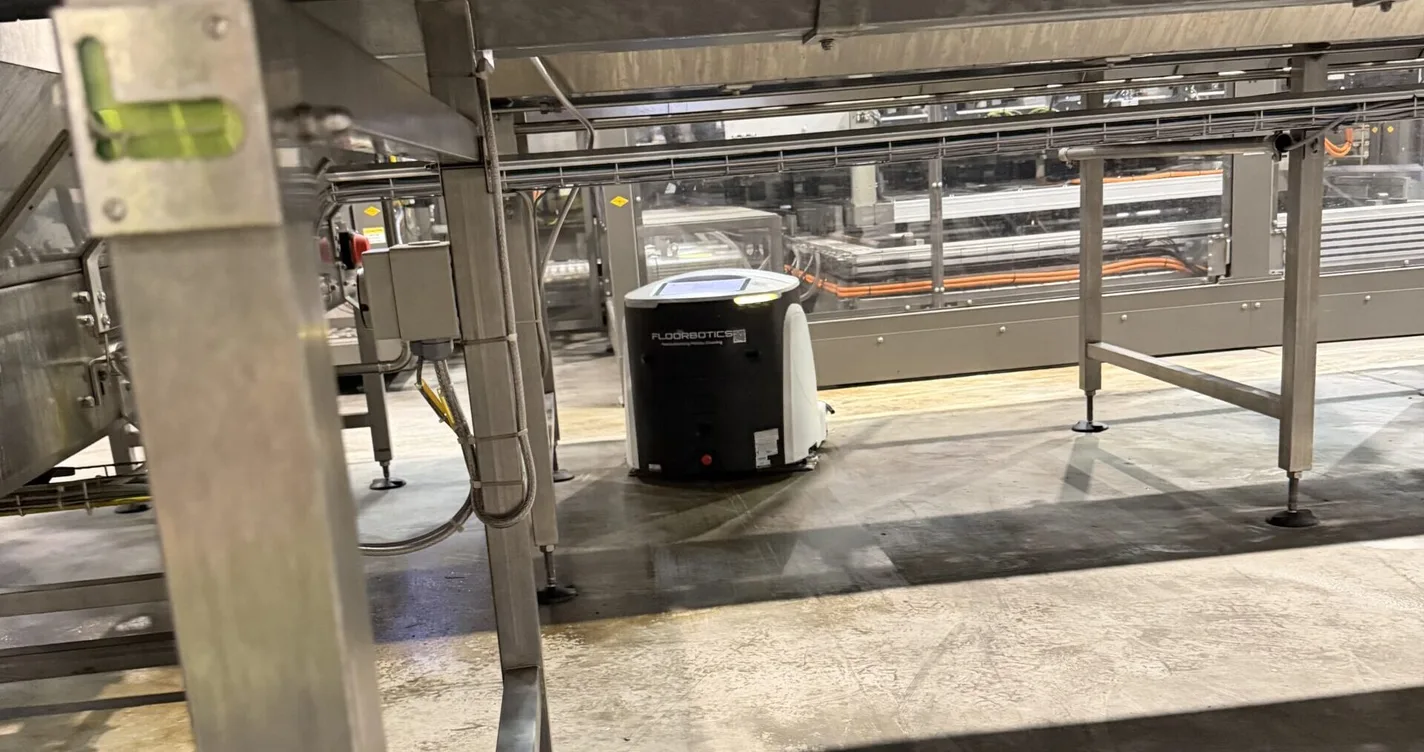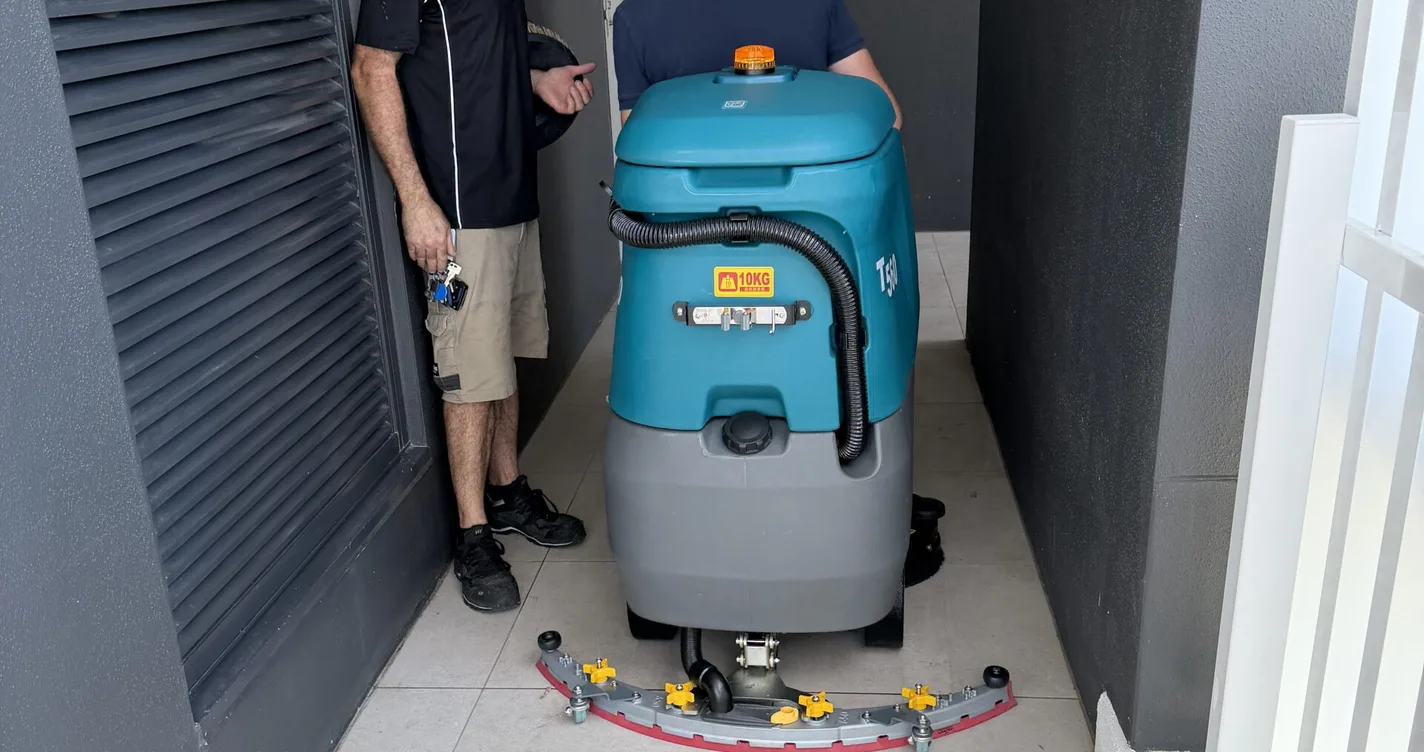
A floor scrubber cleans a concrete floor, but only if the concrete is sealed and the mess is a film rather than loose debris. Bare or porous concrete needs a brush instead of a pad. Loose grit needs a sweeper first. Construction dust and slurry need neither, and running a scrubber through them will damage the machine and cost you a cleaning charge on the hire.
That distinction is the whole job, and almost nobody makes it before booking a machine. Here is how to work out which one your floor actually needs.

Is your concrete sealed or bare?
Check this first, because it decides everything after it. Sealed concrete has a coating, usually epoxy or a penetrating sealer, and water beads or sits on the surface instead of soaking in. Bare or porous concrete drinks the water within a few seconds and shows a dark patch.
Sealed concrete is a forgiving floor. A scrubber lifts the film, the squeegee picks the water back up, and the floor is dry and safe to walk on within minutes. Warehouses, distribution centres, workshops and carparks with a coated slab all fall here, and this is the surface our hire scrubbers are built for.
Bare concrete is a different job. It is abrasive, it holds dirt in the pores, and it eats consumables. Operators tell us bare concrete chews through standard red pads and squeegee rubber in weeks. A machine will still clean it, but you need the right head on it and you should expect to replace wear parts sooner.
The quick test: tip a cup of water on the floor. If it beads, it is sealed. If it soaks in and darkens, it is not.
Do you need a sweeper or a scrubber?
A scrubber lifts a film. A sweeper picks up debris. Most disappointing hires are somebody using one to do the other’s job.
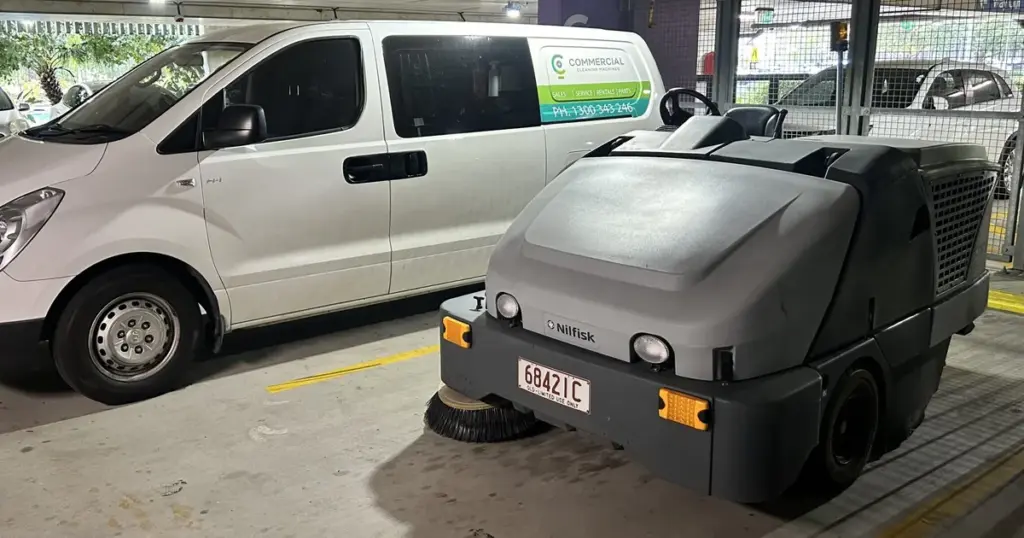
If the floor is covered in sand, grit, dust, leaves or packaging, that is sweeper work. Run a scrubber over it and it drags the mess around, packs the recovery hose, and wears the squeegee blade in a day. A scrubber is not a sweeper, and running one over grit chews through pads and squeegees.
If the floor is swept but grey, greasy or marked with tyre rubber, that is scrubber work. Water, chemical and mechanical pressure lift what a broom cannot.
Most real concrete floors need both, in that order. Sweep or blow the floor first, then scrub. On a large site that means two machines, and it is still faster than one machine doing a job it was not built for. We hire both, and if you are working out which, the floor sweeper hire range covers debris and the floor scrubber hire range covers the film.
Which brush or pad goes on concrete?
Match the head to the surface, not to the machine. This is the part people leave to whoever loads the van, and it is where most of the wear comes from.
- Sealed concrete and epoxy. A disc machine with a pad works well. The surface is smooth, so the pad has something flat to work against.
- Bare, textured or non-slip concrete. A cylindrical brush machine. Bristles reach into the texture where a flat pad only skates across the high points, and brushes survive the abrasion that shreds pads.
- Workshops and floors with loose debris. Cylindrical again. A cylindrical deck can pick up small debris as it works, which a disc deck cannot.

On warehouse concrete we hire the Tennant T7 and the Nilfisk BR755 with a brush rather than a pad, and that single change makes more difference to the result than moving up a machine size.
What size machine does a concrete floor need?
Size follows floor area, not floor type. Concrete does not change the maths, it only changes the head and the wear rate.
Under about 1,000 square metres, a compact walk-behind is enough. Between 1,000 and 3,000, a mid-size walk-behind. Above 3,000, a ride-on, and on a big warehouse slab a ride-on is not a luxury. It finishes in a fraction of the hours and the labour it saves outweighs the higher day rate. The full bands and rates are in what floor scrubber hire costs in Brisbane.
Measure the narrowest door, gate or lift the machine has to pass through before you book. A ride-on that will not fit the roller door is an expensive delivery to watch turn around.
What a hire will not cover: construction dust
This is the one that catches people, and no hire company puts it on the page.
Hire agreements across the industry exclude using a scrubber to clean up concrete dust and construction slurry. Machines come back from building sites with half-set slurry through the tank, the hoses and the recovery system, which has to be chipped out, and the cleaning charge follows. Sometimes it is more than the hire itself.
If your job is a post-pour clean, a grinding cleanup, or anything where the mess is cement dust, a scrubber is the wrong machine regardless of the agreement. Water plus cement dust makes slurry, and slurry sets. That job wants an industrial vacuum or a sweeper with proper dust filtration, and both cost less to hire than a scrubber does.
The order that works on a construction clean: vacuum or sweep the dust out completely, then bring the scrubber in for the film that is left. Not the other way around.

What Brisbane throws at a concrete floor
Two local conditions change the job here. From October through March, storms drop sand, grit and organic debris across industrial floors, yards and carparks, which turns a scrubbing job into a sweeping job overnight. If you have hired a scrubber for a post-storm clean, hire a sweeper with it.
The second is humidity. A porous slab in a Brisbane summer holds moisture, and a floor that has been wet for weeks grows a film that a single pass will not lift. That is a heavier machine, a harder brush and more than one pass, which usually means booking the week rather than the day.
Carparks are their own case. They are almost always bare or lightly sealed, they carry tyre rubber and oil rather than dust, and they are large. Ride-on sweeper first for the debris, then a ride-on scrubber with a brush deck.
How do you book the right machine?
Tell us three things and we can match it on the phone: the floor area in square metres, whether the concrete is sealed or bare, and what is actually on the floor right now. A photo settles the last one faster than a description.
From there we bring the machine, the right deck for the surface, and set it up on site with operator training and breakdown support for the whole hire. Delivery covers Brisbane, the Gold Coast, Sunshine Coast, Ipswich, Logan, Moreton Bay and Toowoomba, often the same day on in-stock machines.
Call 1300 343 246, or start from the cleaning equipment hire hub if you need more than one machine type. If you are weighing a long hire against buying, how to choose a commercial floor scrubber in Brisbane works through the machine choice in more detail.
Common questions
Can a floor scrubber be used on concrete?
Yes, on sealed concrete it is the right machine. On bare or porous concrete it still works, but use a cylindrical brush rather than a pad and expect consumables to wear faster.
What is the best machine for cleaning a warehouse concrete floor?
A ride-on scrubber with a brush deck for floors over about 3,000 square metres, paired with a sweeper for loose debris. On warehouse concrete we hire the Tennant T7 and Nilfisk BR755.
Do you have to sweep before using a floor scrubber on concrete?
Yes. Loose grit is the main cause of clogged recovery hoses and shredded squeegee blades. Sweep or blow the floor first, or hire a sweeper alongside the scrubber.
Can I hire a scrubber to clean up after concreting?
No. Cement dust and water make slurry that sets inside the machine, and hire agreements exclude it. Use an industrial vacuum or a sweeper for the dust, then a scrubber for the film left behind.
Is a disc or cylindrical machine better for concrete?
Disc for smooth sealed concrete and epoxy. Cylindrical for bare, textured or non-slip concrete, and anywhere there is light debris on the floor.